The Dark Reality of Japan – Tokyo: Inside Japan’s Cyber Homeless Epidemic
The Dark Reality of Japan: Beyond the neon lights and futuristic streets lies the dark reality of Tokyo. Discover the hidden world of Japan’s cyber homeless, where thousands are forced to live in 2-square-meter internet cafes.
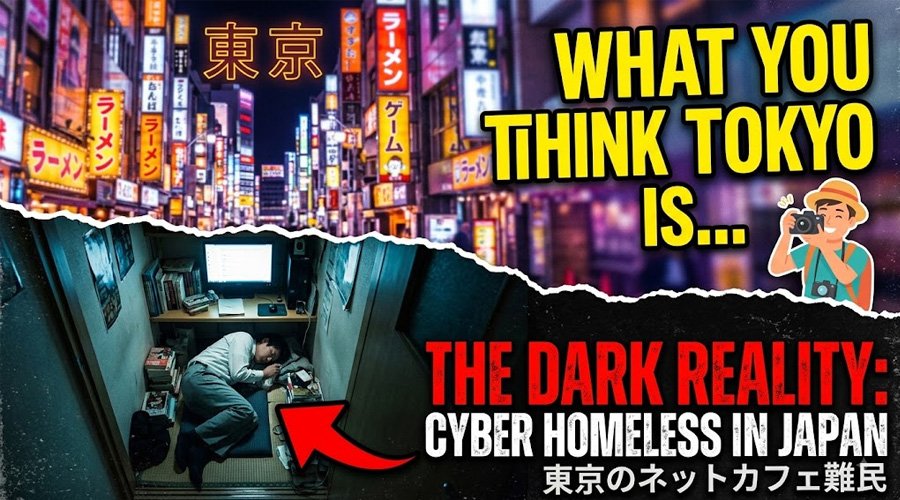
When travelers picture Japan’s capital, they envision a futuristic utopia. It is a metropolis defined by the blinding neon lights of Shinjuku, the spotless public transit systems, and the bustling, anime-filled streets of Akihabara. On the surface, it appears to be a city of extreme wealth and flawless efficiency.
However, if you step off the busy avenues and walk into one of the city’s countless 24-hour internet cafes, you will uncover a shocking parallel universe. Hidden behind sliding doors in near-complete silence is a severe, invisible housing crisis.
This is the dark reality of Tokyo—a world where thousands of working people survive day-to-day as “Cyber Homeless.”
The Dark Reality of Japan : What Are “Net Cafe Refugees”?
In Japan, internet cafes (known locally as netto kafe) offer much more than a simple computer connection. For a low hourly or overnight rate, they provide unlimited soft drinks, vast libraries of manga, and most importantly, private booths equipped with a reclining chair or a padded sleeping mat.
Originally designed as a cheap resting place for businessmen who missed the last train home, these tiny spaces have morphed into permanent housing for the urban poor. The people who live here are known as “Net Cafe Refugees.” They are not sleeping on the pavement, but they are entirely without a permanent physical address, living their lives inside digital cubicles.
The Dark Reality of Japan : Inside the 2-Square-Meter Cyber Slum
To truly understand the dark reality of Tokyo, you have to look at the extreme claustrophobia of these spaces. Living inside a Japanese internet cafe is an exercise in isolation.
-
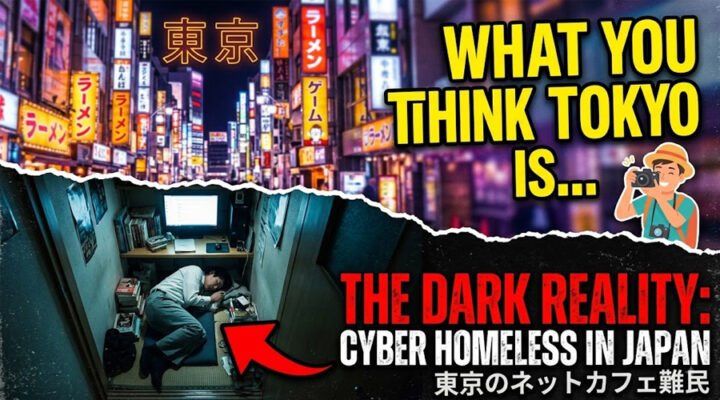
The Micro-Space: The cubicles are typically only 2 square meters (about 21 square feet). They are barely large enough for an average adult to lie down fully. All of a person’s worldly possessions must fit into this tiny, windowless box alongside them.
-
The Silent Environment: The ceilings of these cubicles are open. You can hear every cough, the rustling of plastic bags, and the constant, droning hum of computer cooling fans from your neighbors. Despite the proximity, a strict culture of silence is enforced. There is no natural sunlight, only the perpetual, artificial glow of the monitor.
-
Basic Survival: Residents share communal, coin-operated showers and bathrooms. They survive on cheap convenience store bentos or the free instant soup provided by the cafe’s vending machines.
The Illusion of Wealth: Why is This Happening?
How does one of the most technologically advanced and wealthiest nations on earth have a growing population of cyber homeless? The answer lies in Japan’s shifting and unforgiving labor market.
Following the economic stagnation of the 1990s, Japan saw a massive rise in precarious, part-time, and temporary employment. These workers, often referred to as freeters, earn minimum wage with zero job security, no corporate benefits, and unpredictable shifts.
Renting a traditional apartment in Tokyo requires a massive amount of upfront capital. Tenants often need to pay four or five months of rent in advance just to cover deposits, guarantor fees, and “key money” (a non-refundable gift to the landlord). For a temporary worker earning a daily wage, saving this amount is mathematically impossible. The internet cafe—which requires no deposit, no guarantor, and no background check—becomes the only viable option.
A Trap With No Exit
The most tragic aspect of the dark reality of Tokyo is that this lifestyle functions as a perfect trap.
Because net cafe refugees do not have a permanent physical address, it is incredibly difficult for them to secure full-time, salaried employment. Without a stable job, they cannot save the money required to rent a real apartment. They are stuck in a relentless, exhausting cycle: working temporary daily shifts just to afford another night in a wooden box.
It is an invisible crisis hiding in plain sight. Millions of tourists walk past these brightly lit establishments every year, completely unaware that entire communities are quietly surviving in the shadows just a few feet away.
🎬 Witness the Unseen Reality
Reading about this hidden epidemic is one thing, but seeing the claustrophobic reality is another. Watch the latest fast-paced visual documentary on the Asia Roam Tales YouTube channel, where we strip away the neon illusion and take you inside these hidden 2-square-meter slums.
📥 The Dark Reality of Japan: Uncover More Hidden Truths
At maiduyspacy.com, we look beyond the shiny tourist brochures to uncover the real, unfiltered stories behind the world’s most famous destinations. Explore more of our reality checks, deep-dive documentaries, and backpacking guides today.
Follow Us: https://www.facebook.com/AsiaBackpackTravel/
Read more:
Climbing in Japan: 3 Must-Climb Mountains in Japan – For Every Adventurous Soul
A Budget 7-Day Thailand Backpacking Itinerary